Product · · 6 min read
MongoDB vs PostgreSQL for Chat Applications
Compare MongoDB and PostgreSQL for chat applications, including data modeling, scaling, indexes, transactions, and realtime architecture.
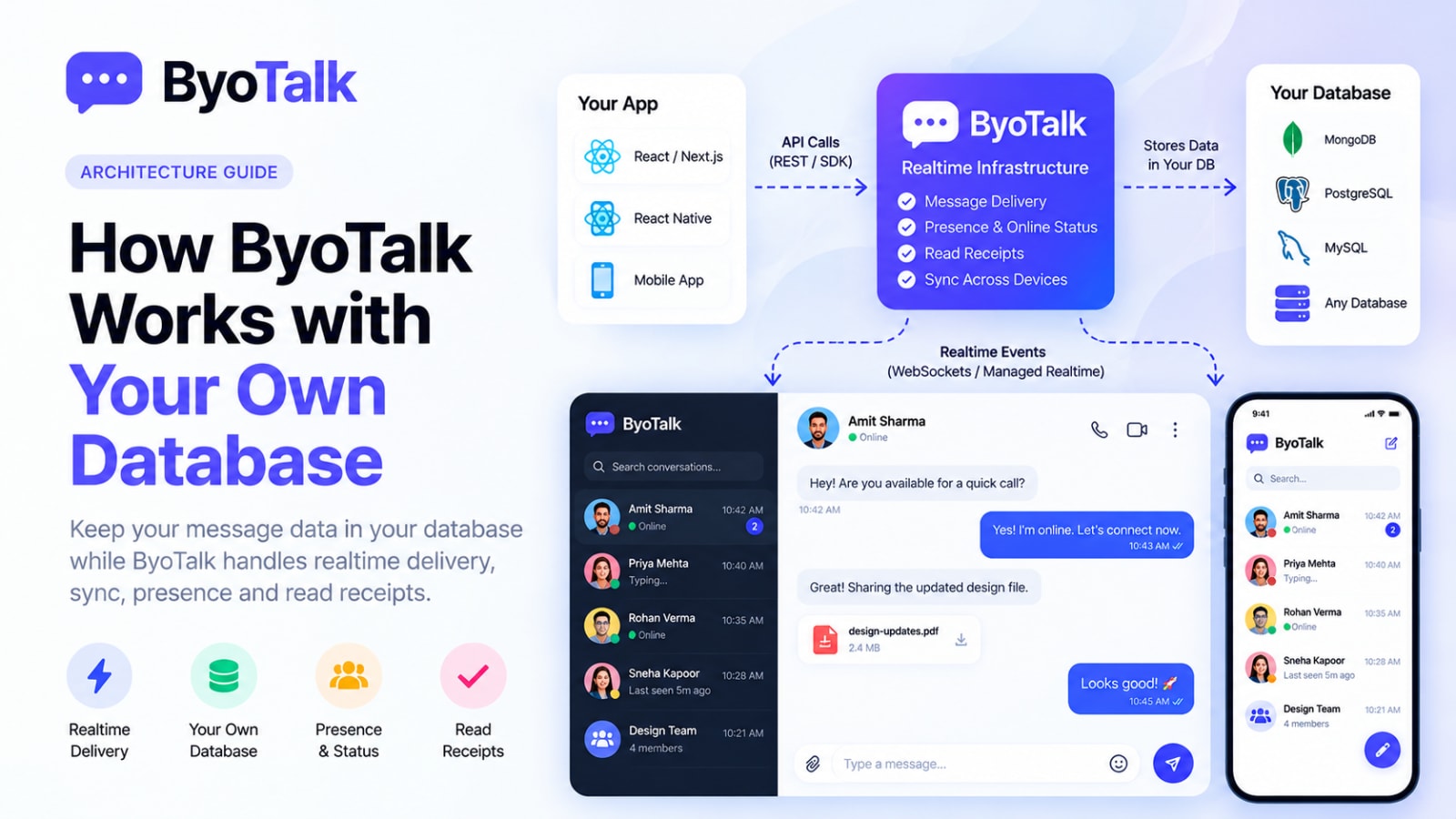
Choosing a database for chat is less about picking the “best” database and more about matching the data model to your product. MongoDB can be a strong fit for flexible conversation data, while PostgreSQL is excellent when relationships, constraints, and transactional workflows are central to the application.
For a realtime chat product, the database is only one part of the architecture. Your application also needs reliable message delivery, synchronization, presence, read receipts, and reconnect handling.
What makes chat data different?
Chat looks simple on the surface, but a production application usually stores more than message text.
A typical schema may include:
- Users
- Conversations
- Participants
- Messages
- Attachments
- Reactions
- Read state
- Delivery state
- Moderation data
- Organization and permission relationships
Some of this data is highly relational. Other parts can be flexible and evolve as the product grows.
The right database depends on how your application needs to query and update these records.
MongoDB for chat applications
MongoDB uses a document-oriented model, which can work well when your chat data changes frequently or contains nested structures.
A conversation document can represent metadata while messages are stored in a related collection. Documents can also accommodate optional fields without requiring every record to have the same rigid shape.
MongoDB can be attractive when:
- Your application already uses MongoDB.
- Your data model changes frequently.
- You want flexible document structures.
- Your team is comfortable with the MongoDB ecosystem.
- Your chat features include varied metadata and payloads.
For many JavaScript and TypeScript teams, MongoDB also fits naturally into an existing Node.js stack.
PostgreSQL for chat applications
PostgreSQL provides a relational model with strong constraints, transactions, joins, indexes, and mature querying capabilities.
That can be especially useful when chat is deeply connected to other application entities.
For example, an enterprise application may need to query conversations together with:
- Organizations
- Teams
- Projects
- Customers
- Subscriptions
- Permissions
- Billing records
PostgreSQL can be a strong choice when these relationships are an important part of the product.
MongoDB vs PostgreSQL for chat
The practical comparison is less about raw database performance and more about how your application works.
| Requirement | MongoDB | PostgreSQL |
|---|---|---|
| Flexible message metadata | Strong fit | Strong with JSONB |
| Complex relationships | Possible | Excellent |
| Transactions | Supported | Excellent |
| Existing Node.js stack | Strong fit | Strong fit |
| Rigid relational constraints | Less central | Excellent |
| Rapid schema evolution | Strong fit | Good |
| Complex reporting queries | Good | Excellent |
| Existing infrastructure | Use what your team knows | Use what your team knows |
Both can support serious chat applications.
How message storage should be designed
Regardless of the database, avoid treating a chat message as only a piece of text.
A useful message record might contain:
- Stable message ID
- Conversation ID
- Sender ID
- Message body
- Created timestamp
- Edited timestamp
- Delivery metadata
- Attachment references
- Reply or thread references
- Application-specific metadata
Stable identifiers are especially important for realtime systems because clients may reconnect or retry operations.
If the client sends a message twice after a network interruption, the server needs a way to recognize the operation and avoid creating duplicate records.
Database design is not realtime infrastructure
One important architectural distinction is that your database should not be responsible for maintaining every live connection.
A database stores durable state. Realtime infrastructure handles fast event delivery between connected clients.
For example:
- A user sends a message.
- Your application validates the request.
- The message is stored in MongoDB or PostgreSQL.
- A realtime event is delivered to other connected clients.
- The recipient's UI updates immediately.
- Delivery and read events can be synchronized separately.
This separation makes the architecture easier to reason about.
What about presence and typing?
Presence and typing indicators are transient.
A user can go from online to offline many times during a session. A typing indicator may exist for only a few seconds.
Persisting every transient event as a normal database record can create unnecessary traffic and storage.
Instead, a realtime layer can handle events such as:
- Online and offline state
- Typing indicators
- Delivery events
- Read receipts
- Connection state
- Synchronization signals
Durable information that the application actually needs can still be stored in your database.
Scaling chat with MongoDB
MongoDB can scale horizontally, but chat applications still require careful data modeling.
Avoid designs that force every conversation request to scan large collections. Index fields that are frequently used for lookups, such as conversation ID, participant ID, and message timestamp.
A common query is:
“Give me the latest messages for conversation X.”
That query should be supported by an appropriate index and pagination strategy.
Cursor-based pagination is often preferable to repeatedly using large offsets for high-volume conversations.
Scaling chat with PostgreSQL
PostgreSQL can also support large chat workloads when tables, indexes, queries, and connection management are designed correctly.
For high-volume message tables, consider indexing by conversation and creation time. Depending on workload and retention requirements, partitioning can also become useful.
The important point is that database scaling should be driven by actual workload characteristics rather than assumptions about which database is universally faster.
Which database should you choose?
Start with the database your product and team already understand.
If your existing application runs on MongoDB and its data model is document-oriented, adding chat to MongoDB may be the simplest choice.
If your product already uses PostgreSQL and chat is closely connected to relational entities, PostgreSQL may be the natural option.
Migrating databases only because another technology is popular often creates more operational work than value.
A BYO-database approach
A realtime chat platform does not need to force you into a particular database.
With a BYO-database architecture, your application can keep permanent messages and business data in the database it already uses while a managed realtime layer handles delivery and synchronization.
That means a MongoDB application can keep MongoDB.
A PostgreSQL application can keep PostgreSQL.
The realtime infrastructure remains focused on what it does best: getting events to connected users quickly and reliably.
Common mistakes to avoid
Choosing based only on benchmarks
Database benchmarks rarely represent your exact workload. Measure the queries, writes, indexes, and traffic patterns that your application actually produces.
Storing every transient event
Typing and presence events do not need to become permanent rows or documents in most systems.
Ignoring indexes
A chat system can generate a large number of messages quickly. Query patterns should be considered before production traffic arrives.
Mixing business logic into the realtime layer
Authentication, authorization, billing rules, and application-specific permissions should remain under your application's control.
Forgetting reconnects
A database choice cannot solve synchronization problems by itself. Clients need stable IDs and a strategy for recovering after connection loss.
FAQ
Is MongoDB or PostgreSQL better for chat?
Neither is universally better. Choose based on your existing architecture, query patterns, relationships, team expertise, and operational requirements.
Can PostgreSQL handle realtime chat?
Yes. PostgreSQL can be the durable database behind a realtime chat application. Realtime delivery can be handled by a separate infrastructure layer.
Can MongoDB store millions of chat messages?
MongoDB can support large workloads when collections, indexes, queries, and scaling strategies are designed appropriately.
Do I need to change my database to add realtime chat?
No. A realtime architecture can sit alongside your existing application and database. A managed realtime service can handle event delivery while your database remains the source of truth.
Choose the database that fits your product
The best database for chat is usually the one that fits the rest of your application.
MongoDB is a practical choice for teams that prefer flexible document structures. PostgreSQL is a strong choice when relational data, constraints, and complex queries are important.
The realtime layer is a separate concern. ByoTalk can handle realtime delivery, synchronization, presence, and read receipts while your application continues using its own database.
For more architecture guidance, read How to Build Realtime Chat Without WebSockets, Realtime Chat Presence and Read Receipts, and How to Design a Realtime Chat UI.
- chat-infrastructure
- byo-database
- realtime
Build chat on ByoTalk
Realtime chat and calls, with the permanent record in your own database.