Product · · 7 min read
How to Build Realtime Chat Without WebSockets
Learn how to add realtime chat without managing WebSocket infrastructure, while keeping your business logic and permanent chat data under your control.
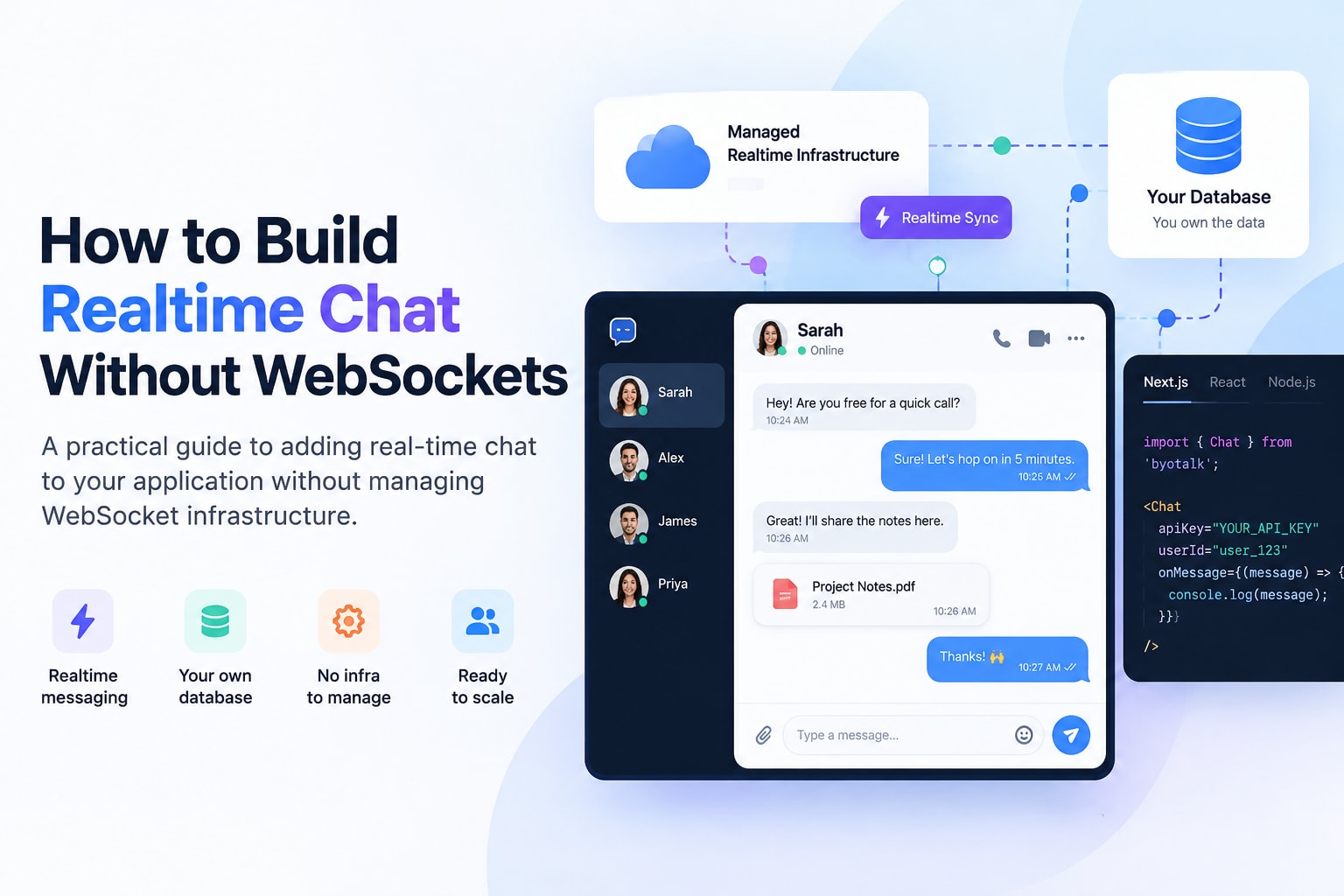
If you want realtime chat without WebSockets, you do not necessarily need to build and operate a WebSocket server yourself. The simpler approach is to use a managed realtime layer that handles persistent connections, message delivery, synchronization, presence, and reconnects while your application focuses on users, conversations, permissions, and business data.
WebSockets are excellent technology for two-way realtime communication. The WebSocket protocol was designed to let clients and servers exchange data over a persistent connection instead of repeatedly polling over HTTP. But running that infrastructure in production is a much bigger job than opening a socket in the browser.
Why realtime chat gets complicated
A basic chat demo can be surprisingly small. You open a connection, send a message, listen for incoming messages, and render them in the UI.
Production chat is different.
You need to think about:
- Connection lifecycle and reconnects
- Message ordering and duplicate delivery
- Offline users and missed messages
- Presence and typing indicators
- Read receipts
- Authentication and authorization
- Horizontal scaling across multiple server instances
- Push notifications when users are offline
- Monitoring and operational failures
- Data persistence and recovery
The WebSocket API itself gives you the connection and events, but your application still has to decide what happens around that connection. MDN's WebSocket documentation covers the basic connection, message, error, and close lifecycle; those primitives are useful, but a production chat system needs considerably more application logic around them.
WebSockets are not the problem
It is worth making an important distinction: WebSockets are not bad, outdated, or something you should automatically avoid.
They are a solid foundation for realtime applications. The IETF WebSocket specification defines a two-way communication channel that allows either side to send messages independently after the connection is established.
The problem is ownership.
If your product team owns the realtime infrastructure, you also own the operational details surrounding it. You need to keep connections healthy, distribute events between instances, recover from disconnects, and make sure the chat experience remains consistent when users move between networks or devices.
For a small internal application, that may be completely reasonable.
For a product team whose main business is not realtime infrastructure, it can become a significant engineering surface.
What a managed realtime layer changes
A managed realtime service moves the infrastructure layer outside your application.
Instead of building this:
Your app
   ↓
WebSocket server
   ↓
Connection management
   ↓
Message routing
   ↓
Presence / receipts / sync
   ↓
Database
you can build around a simpler boundary:
Your app
   ↓
Managed realtime chat
   ↓
Your database
Your application still owns the important product decisions. You decide who can talk to whom, what conversations exist, what your users can access, and what permanent data your business needs.
The realtime layer handles the communication mechanics.
That separation can make the system easier to reason about and easier for a small engineering team to maintain.
What you still need to build
Using managed realtime infrastructure does not mean handing your entire application to another service.
Your backend should still own business-critical concerns such as:
Authentication
Your application should authenticate users and establish which conversations they are allowed to access.
Authorization
A user being authenticated does not automatically mean they should be able to read every conversation. Conversation membership and permissions should remain part of your application's business rules.
Permanent data
Decide what belongs in your own database. For many products, messages, conversation membership, user relationships, and application-specific metadata are important business records.
This is especially useful when you want to query chat data together with the rest of your application data.
Business events
Your application may need to react when a message is sent, a conversation is created, or a user joins a group. Webhooks or server-side events can keep your backend synchronized with the realtime system.
The database question matters
One of the biggest architectural decisions is where the permanent chat record lives.
A hosted chat product can make getting started extremely fast, but some teams eventually need direct control over their data. They may need to join conversations with customer records, run internal reporting, create backups, apply their own retention policies, or migrate the data later.
A BYO database approach gives you that ownership.
With ByoTalk, the realtime layer can handle delivery and synchronization while the permanent record remains in a database you control. That means chat does not have to become an isolated data island inside your architecture.
You can read more about this approach in Introducing ByoTalk: realtime chat that writes to your own database.
A practical architecture
For a typical web application, a useful architecture looks like this:
- The user signs in to your application.
- Your backend determines the user's identity and permissions.
- The client connects to the realtime service using an authenticated session.
- Messages are delivered through the realtime connection.
- The realtime layer handles connection state and synchronization.
- Your application keeps the permanent record in your database.
- Your backend receives relevant events when business logic needs to react.
- Offline users receive notifications through your existing notification infrastructure.
The important part is the boundary: realtime delivery is separated from your core business database and application logic without forcing you to give up ownership of the data.
What happens when a user disconnects?
This is one of the areas that makes chat infrastructure harder than a simple WebSocket demo.
A user's Wi-Fi can disappear. A laptop can sleep. A mobile device can switch from Wi-Fi to cellular. A browser tab can be suspended.
Your application needs a reliable strategy for reconnecting and determining what the user missed.
That usually means combining connection state, message identifiers, synchronization, and persistence.
A managed realtime layer can take responsibility for much of this infrastructure. Your application can then concentrate on rendering the conversation and deciding what the message means to the business.
Build it yourself vs managed realtime
Building your own realtime infrastructure can be the right choice when realtime communication is itself a core part of your engineering expertise or when you need very specialized behavior.
A managed solution is often more attractive when your goal is simply to add reliable chat to an existing product.
Consider these questions:
| Question | Build yourself | Managed realtime |
|---|---|---|
| Do you need custom transport behavior? | Strong fit | May be limiting |
| Do you want full infrastructure control? | Strong fit | Less operational control |
| Is realtime infrastructure your core product? | Strong fit | Usually unnecessary |
| Do you want to reduce infrastructure work? | More effort | Strong fit |
| Do you need your own permanent database? | Yes | Possible with BYO database |
| Do you need fast implementation? | Usually slower | Usually faster |
There is no universal winner. The right architecture depends on how much realtime infrastructure your team actually wants to own.
You can keep the developer experience simple
The biggest benefit of managed realtime chat is not that WebSockets disappear from the internet. They are still an underlying technology that many realtime systems use.
The benefit is that your application does not have to become a WebSocket infrastructure project.
Instead of maintaining connection servers, routing events, handling reconnect edge cases, and designing synchronization protocols, your developers can work with higher-level concepts such as users, conversations, messages, presence, and events.
That is a much better abstraction for most product teams.
When should you use this approach?
Managed realtime chat is particularly useful when:
- You already have a web or mobile application.
- Chat is a feature rather than your primary product.
- Your team wants to move quickly.
- You need realtime delivery but do not want to operate socket infrastructure.
- Your organization wants permanent data in its own database.
- You expect chat usage to grow and do not want to redesign the infrastructure later.
For a small prototype, a direct WebSocket implementation may be perfectly fine. For a production product, the operational cost should be considered alongside the initial development cost.
Frequently asked questions
Can I build realtime chat without WebSockets?
Yes. Your application does not have to manage WebSocket connections directly. A managed realtime service can provide the realtime communication layer while your application uses a higher-level SDK or API.
Are WebSockets still used by managed chat services?
They can be. The important distinction is that your team does not have to operate the underlying connection infrastructure itself.
Should chat messages live in my database?
If messages are important business records, keeping the permanent record in a database you control can provide better ownership, querying, backup, reporting, and integration options.
Is building a WebSocket server difficult?
A basic WebSocket server is relatively straightforward. The complexity grows when you add authentication, scaling, reconnects, message synchronization, presence, receipts, monitoring, and production reliability.
Start building realtime chat without owning the infrastructure
Realtime chat should add value to your product, not force your team to become experts in connection management and distributed messaging infrastructure.
If you want the realtime experience without operating all of the underlying infrastructure, ByoTalk provides a managed chat layer while allowing you to keep the permanent record in your own database.
Try ByoTalk and start building realtime chat without managing the WebSocket infrastructure yourself.
Further reading
- realtime
- byo-database
- chat-infrastructure
Build chat on ByoTalk
Realtime chat and calls, with the permanent record in your own database.